


Oct . 11, 2025 10:25 Back to list
Chemical Anchor Bolt | Heavy-Duty, Fast, Corrosion-Resistant
What’s Really Going On With the chemical anchor bolt market
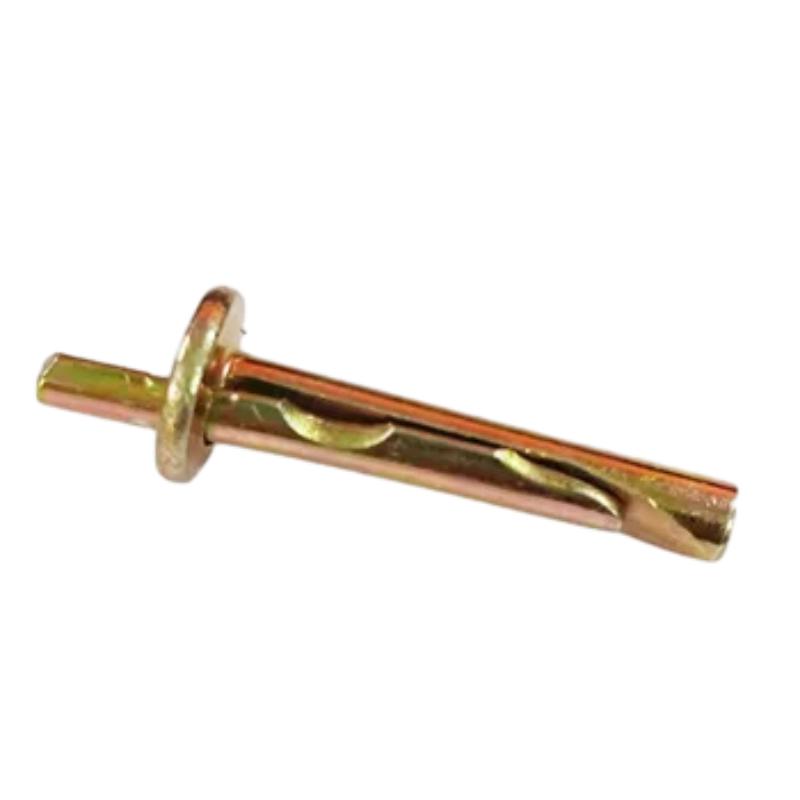
I’ve been walking job sites long enough to know one thing: ceiling fixes live or die by their anchors. And yes, naming gets fuzzy—this model is technically a hammer-set expansion type, but everyone still calls it a chemical anchor bolt on the purchasing sheet. Fair enough. The product in question—Chemical Anchor Bolt Yellow Zinc Plated Carbon Steel Ceiling Anchor—has been gaining quiet popularity because it’s fast, forgiving, and inexpensive. To be honest, that combo is hard to beat for lightweight suspended ceilings.
What it is (and why crews like it)
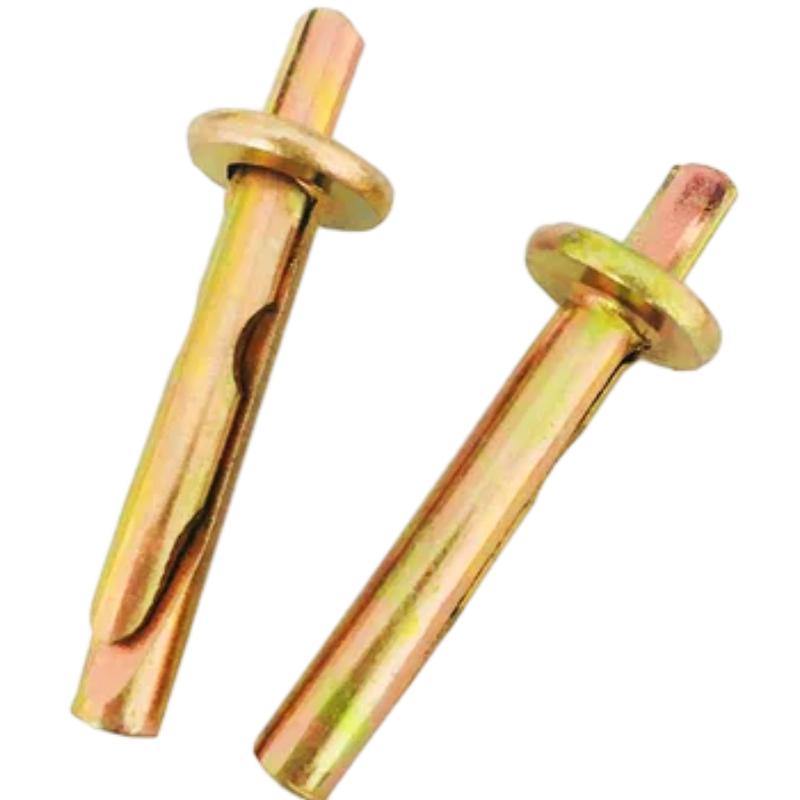
It’s a ceiling wire hanger anchor for installing lightweight and suspended ceilings into solid substrates. Impact expansion by hammer—no setting tool. Works in cracked and non-cracked concrete, and it doesn’t demand pristine hole cleanliness. With increased embedment, the tension capacity rises—so you can “tune” performance by depth (within spec). It’s also known as a through bolt, expansion bolt, or expansion anchor, designed for consistent behavior in concrete.
Origin and traceability matter: manufactured in Hebei’s fastener hub at No. 40, Zhuoju Road, Dongmingyang Industrial Park, Mingguan Town, Yongnian District, Handan City, Hebei Province, China. Many customers say the steady QC and short lead times are the real draw.
Key specifications
| Body material | Carbon steel (≈ Grade 5.8); optional stainless (304/316) |
| Finish | Yellow zinc plated (≈5–8 μm), salt spray ≈ 48–72 h; real-world use may vary |
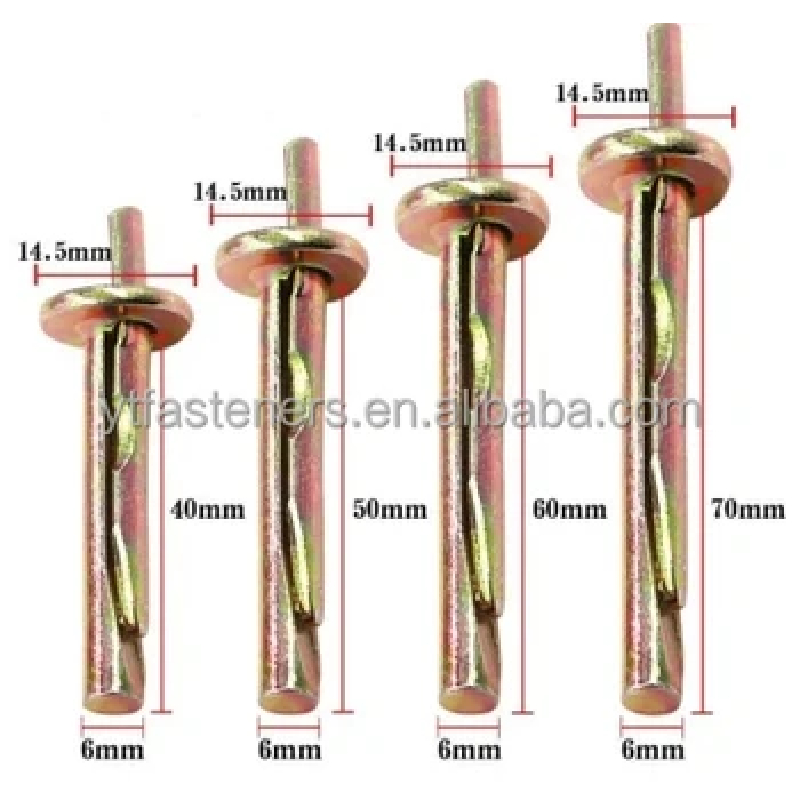
| Typical sizes | M6, M8, M10 (others on request) |
| Drill hole Ø (d0) | Nominal bolt size (tolerance around +0.5 mm) |
| Embedment depth | ≈ 25–50 mm (deeper embedment → higher tension, within code) |
| Concrete | Cracked and non-cracked concrete, C20/25–C30/37 |
| Characteristic tension (guide) | M6 ≈ 2.0–3.0 kN; M8 ≈ 3.5–4.5 kN; M10 ≈ 5.0–6.0 kN |
| Characteristic shear (guide) | M6 ≈ 2.0–2.5 kN; M8 ≈ 3.0–4.0 kN; M10 ≈ 4.5–5.0 kN |
| Temperature | -40°C to +80°C continuous; short-term spikes to +120°C |
| Service life | ≈ 30–50 years in dry interiors; use stainless near moisture/chemicals |
Note: On-site tests govern. Design per EN 1992-4 / ACI 318. Values are indicative.
Installation workflow (field-proven)
- Drill to required depth; hole cleanliness: brush/blow is recommended, but this anchor is forgiving.
- Insert the chemical anchor bolt; hammer to seat and expand (no special tool needed).
- Set embedment per load calc; verify with torque/check or light proof-load as required.
- Testing: pre-production per ACI 355.2 / ICC-ES AC193; jobsite proof loads for sample points.
Where it shines
Suspended ceilings, MEP trapezes for light loads, signage, cable trays, and acoustic baffles in malls, offices, schools. Actually, it’s the “get it done today” choice when concrete cavities vary and time is tight.
Real-world case
Guangzhou retail fit-out (Phase 2): 4,200 pcs of chemical anchor bolt M8 installed in C25 concrete. Random pull-out tests averaged 4.2 kN (min 3.7 kN) at 35 mm embedment; zero cone failures observed in sample. Superintendent’s note—“faster than sleeve anchors, no drama.”
Vendor snapshot (my short list)
| Vendor | Docs & Standards | Lead Time | Customization | Price Index |
|---|---|---|---|---|
| YTBolt (Hebei) | Factory test reports aligned with AC193 / ACI 355.2; ISO 9001 | ≈ 7–15 days | Logo, length, stainless option | $ (budget-friendly) |
| Import Brand A | ETA per ETAG 001/EN 1992-4, full DoP | ≈ 3–6 weeks | Limited | $$$ |
| Budget No-Name B | Minimal paperwork; basic CoC only | ≈ 10–20 days | Unclear | $ |
Trends and buying notes
- Shift to design-per-EN 1992-4 worldwide—even on small tenant fit-outs. Good trend.
- Installers prefer hammer-set anchors for ceilings: no curing time, predictable expansion.
- Ask for job-lot pull test data; many crews now require 1.5× service load proof tests.
- Corrosion: yellow zinc is fine indoors; go stainless near HVAC condensate or pools.
If you need a fast, economical ceiling hanger—this chemical anchor bolt is a practical pick. And if you care (you should), ask the vendor for batch traceability and salt-spray snapshots. Surprisingly, more shops have that ready than you’d think.
Authoritative references
- ACI 355.2-19: Qualification of Post-Installed Mechanical Anchors in Concrete
- ICC-ES AC193: Acceptance Criteria for Mechanical Anchors in Concrete Elements
- EN 1992-4:2018, Design of fastenings for use in concrete
- ETAG 001 / EAD 330232: Metal anchors for use in concrete
-
Guide to Calculating the Best Expansion Anchor Bolt Length
NewsApr.16,2026
-
Guide to the Correct Drill Size for 3 8 Wedge Anchor Installation
NewsApr.09,2026
-
Comprehensive Guide to Dottie Wedge Anchor Selection and Installation
NewsApr.07,2026
-
Comprehensive Guide to Ceiling Wedge Anchors for Secure Installations
NewsApr.04,2026
-
Understanding the Versatility and Applications of Carbon Steel Wedges
NewsMar.31,2026
-
The Essential Guide to Bolt Wedges Strength and Application
NewsMar.28,2026
 English
  Bengali
  Bulgarian
  Catalan
  Czech
Czech  French
  German
  Hindi
Hindi  Hungarian
  Italian
  Kazakh
  Korean
  Portuguese
  Romanian
  Slovak
  Somali
  Spanish
  Turkish


